

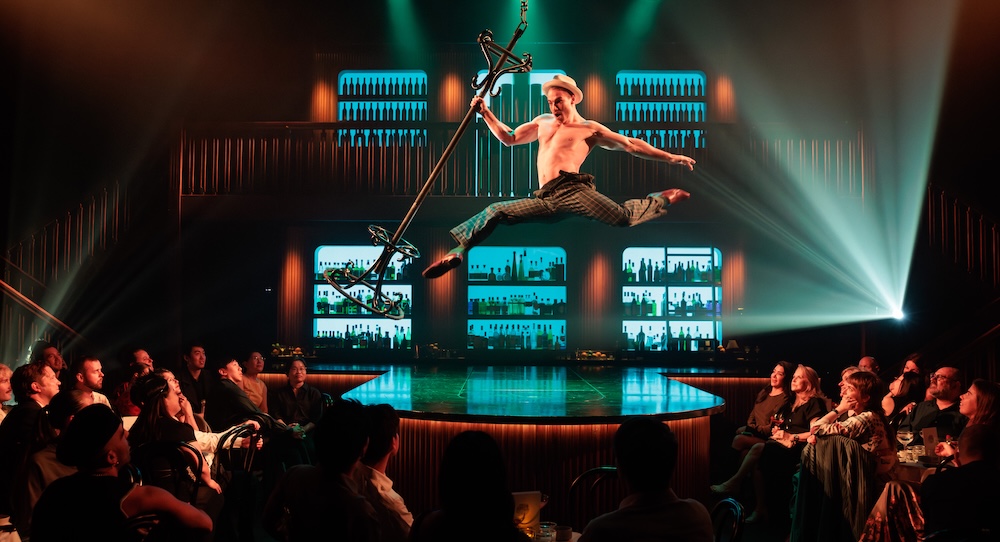
The Studio, Sydney Opera House.
17 December 2025.
From the moment the doors open, Gatsby at The Green Light makes it clear this is not a show to be watched passively. The Studio at the Sydney Opera House is transformed into a low-lit speakeasy where performers are already in motion – pouring drinks, waiting tables, flirting shamelessly and weaving through the audience. You are not just attending a performance; you are stepping into the party.
Inspired loosely by F. Scott Fitzgerald’s The Great Gatsby, the narrative is delivered through a series of cabaret, circus and dance acts, stitched together by music, atmosphere and fleeting moments of dialogue. Rather than retelling the story in any literal sense, the production captures its essence – desire, decadence, nostalgia and excess – and filters it through a contemporary lens that feels both indulgent and knowingly modern.
A standout presence throughout the night is Odette (Georgia Sallybanks), whose rich, soulful vocals anchor the show. She commands the space with conviction, sensuality and ease, effortlessly engaging the room as dancers from the service ensemble swirl around her. The choreography amplifies her numbers, adding texture and momentum, and her performances become emotional touchstones within the revelry.
Sensuality and energy are the driving forces of this production. Every performer appears to give themselves fully to the work, embracing the mash-up of 1920s glamour and 2020s club culture with unapologetic commitment. The result is a show that pulses relentlessly, often placing performers so close you feel the rush of air as they fly past, and perhaps their sweat.
As Gatsby, Spencer Craig is positioned as a connective thread, appearing intermittently like a shadow to his younger self, Jacob McPherson, gazing outward in moments of longing. While the framing hints at Gatsby’s isolation and regret, Craig’s role ultimately feels underdeveloped. His appearances lack narrative weight, and his final routine with Daisy (Caitlin Thomson-Moylan) comes too late to deepen their relationship meaningfully. Thomson-Moylan, by contrast, is consistently magnetic, delivering aerial sequences of striking strength and beauty that far outshine this final pairing.
The supporting cast, however, is where the show truly soars. Oscar Kauffman is a highlight – suave, cheeky and impeccably styled in plaid suite and bowler hat, which he slowly lost pieces of throughout his routine. His hat-stand act and dapper persona perfectly evoke the spirit of the 1920s, blending technical brilliance with irresistible charm.
Miranda Menzies delivers a performance that is undeniably skilled yet deliberately unsettling. Her contortion and hair-hang work is extreme, confrontational, and her expression at times, uncomfortable. While this excess may alienate some viewers, it aligns with the show’s desire to push boundaries and disrupt comfort – a reminder that decadence often carries a darker edge.
As the club’s hostess, Bettie Bombshell brings warmth, humour and classic burlesque flair. From the outset, she works the room with ease, engaging patrons seated around tables before launching into a fiery burlesque act featuring fire twirling, fire eating and a confident striptease. She understands audience connection instinctively, delivering a performance that is both playful and commanding.
The service ensemble dancers are integral to the immersive experience. Moving constantly through the space – on stairs, banisters and between tables – they blur the line between performer and host. At one point, they draw audience members onto the floor to dance alongside them. Choreographed by Lucas Newland (with Assistant Cassie Bartho), the movement is detailed, dynamic and spatially intelligent, making full use of the venue while maintaining intimacy and drive.
Among the evening’s crowd-pleasers, Tomy Egan dazzles with his world-class tap technique, combining effortless precision with natural charisma. Florian Brooks, the juggling bartender, offers a gentler counterpoint – sweet and Chaplin-esque, his ethereal presence adding whimsy to the night’s excess.
Aerial work features prominently, with Mariia Borysiak and Jacob McPherson delivering a tender and visually stunning corde lisse duet that captures the yearning of young love. Thomson-Moylan’s aerial performances further elevate the show, each appearance drawing gasps with their power and elegance.
The production is underscored by a well-curated soundtrack that blends pop, R&B and club beats, reinforcing the contemporary pulse beneath the vintage sheen. Lighting design sharpens the atmosphere, carving the space into pockets of intimacy and spectacle, and ensuring every corner of the venue feels alive.
Ultimately, Gatsby at The Green Light succeeds as an immersive, high-energy night out distinguished by the calibre of its artists. This is a world-class assembly of performers drawn from across the globe, each exceptional in their own right, curated with care into a single, electrifying experience. While the central Gatsby thread may lack narrative clarity, the collective strength of the work more than compensates. What unfolds is not simply a retelling of a familiar story, but a rare convergence of international talent – aerialists, dancers musicians and circus artists – brought together in one space. We are fortunate to witness this level of artistry unified in a single show: Gatsby not as literature, but as lived experience – a decadent, champagne-soaked celebration that lingers long after the lights fade.
By Linda Badger of Dance Informa.
