

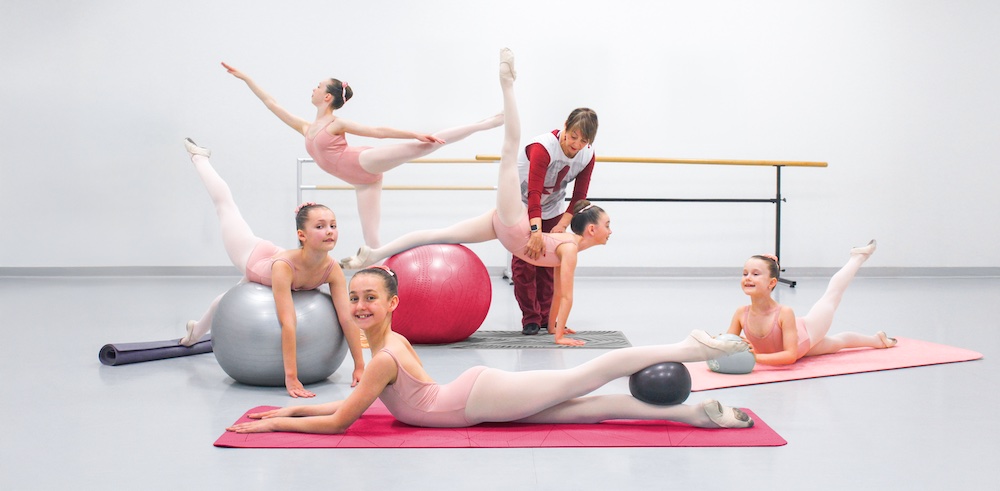
In the 1980s, Marie Walton-Mahon, OAM, began laying the foundations of what she would later call Progressing Ballet Technique (PBT). In 2005, she began testing the work and forming the core of the program. PBT today is worldwide and taught in thousands of schools in 40 countries. Teachers and dancers alike sing the praises of the methodology, mentioning its ability to bridge the gap between conditioning and technique. At age 72, Walton-Mahon shows no signs of slowing down — rather, the opposite. She is just hitting her stride and continues to innovate PBT and its mission of revolutionising dance education through innovative and mindful training.
PBT has become a staple in dance studios around the world. What first sparked the idea for developing this technique?
“After retiring from my professional ballet career in France, I returned to Australia to open up my own ballet school. My mission through the school was to create a learning environment where every dancer could thrive and discover their own potential, regardless of their individual physical capabilities. When students aren’t moving forward and seeing improvement in themselves, they become discouraged and disengaged, so I wanted to fix that problem and started diving deep into anatomy study to understand further how the body moves in relation to dance.
In the early 1980s, I started experimenting with different types of equipment such as exercise balls during class. The idea was to use the equipment to remove the pressure of the body’s weight and focus on the fundamentals of a position and how the body moves. The results were fairly immediate in these young experiments and the young dancers lit up with curiosity and excitement.”
Was there a specific moment or challenge you witnessed in training dancers that made you realize something was missing in traditional ballet education?
“Absolutely. Over my 50 years of teaching and adjudicating across the world, I have observed many trends — but one in particular has been deeply concerning. Increasingly, students are fixated on how high they can lift their legs or how many pirouettes they can perform, rather than concentrating on the essential foundations that ensure safe and sustainable progress, with the ‘how’ and the ‘why’ behind a movement often being bypassed entirely. This focus on spectacle over substance has only been magnified in recent years by the influence of social media. It became clear that something was missing — not in the syllabus itself or any particular choreography, but in the education of body awareness within students. The most dazzling performance depends on deeply rooted technique and strong foundation.”
PBT bridges the gap between ballet and somatic training. What were some of your guiding principles when developing the curriculum?

“One of the core guiding principles behind PBT has always been progression with purpose. The program is structured around the development of each individual’s personal best, rather than rushing towards performance-based outcomes.
Key pillars such as alignment, core stability, posture and weight distribution form the bedrock of the program. These are not just technical goals — they’re somatic principles that train the body to move intelligently, with awareness and control. PBT provides a framework where students learn how their bodies function best, helping them grow with confidence and avoid common injuries, no matter their natural facility.”
The use of props in PBT is ingenious. How did you land on using tools like the stability ball to translate ballet concepts?
“The use of props in PBT came from the excitement I witnessed in a group of young students back in the 1980s. I began experimenting with exercise balls and quickly saw how the unstable surface provided instant feedback and how important it was to take the pressure of weight off the body when perfecting a movement. It awakened their body awareness in a way traditional methods couldn’t. They were completely engaged, laughing while trying to keep the ball still, and at the same time learning about alignment and core control. When you have students genuinely enthusiastic about discovering how their body works — it’s a win. That joy, combined with the somatic awareness these tools inspired, became the foundation for integrating props as a core part of PBT.”

In what ways do you see PBT helping to prevent injuries or correct long-standing technical habits in dancers?
“Absolutely. If the alignment of the pelvis, knees and ankles are not secure, injuries are almost inevitable — particularly during repeated movements such as allegro. Take, for example, the landing from a jump: if a dancer lands in a pronated position, that misalignment becomes tomorrow’s injury. By removing the pressure of weight-bearing, dancers can refine their movement pathways and truly feel alignment through controlled, supported motion. It’s about safety first — building awareness, strength and alignment from the inside out so that long-standing habits can be corrected and injuries prevented before they start.”
What has this journey taught you about your own body and movement practice?
“This journey has taught me that anything is possible. A few years ago, it was public knowledge that I suffered a serious fall from my bike, breaking my sacrum and sustaining nerve damage. I returned home from the hospital using a walker, barely able to shuffle. I began doing PBT daily from bed, starting with the Sub-Junior level. The doctors were amazed at my recovery — and just a few months later, I was able to deliver a full PBT course.
More recently, I was involved in a car accident that left me with whiplash and deep bruising. Once again, daily PBT played a key role in my recovery. Now in my 70s, I’m proud of my posture, balance and core stability. I truly believe age is just a number when you move with purpose and care.”

What’s next for PBT? Are there new areas you’re exploring or dreaming about expanding into?
“If you stay at the same level, you’re actually moving backwards. At PBT, our team is always striving to refine and evolve the program, finding new ways to support both students and teachers. We actively listen to feedback from our global community and feel incredibly fortunate to have so many passionate teachers who share their ideas and needs with us.
This year, we’ve been deeply focused on developing an official PBT curriculum. This extensive project includes hundreds of new exercises and a structured 40-week progression, designed for students of all levels. We’re also responding to strong demand for an expanded adult PBT program, which will be another key focus this year. In addition, we’re excited to be collaborating with two Olympic gymnasts on a new initiative: PGT (Progressing Gymnastics Technique).”
If you could go back and give your younger teaching self a piece of advice, what would it be?
“This is the easiest question of them all. A young Marie was a perfectionist, always placing pressure on herself to achieve more and more. If I could speak to that young woman, I’d say, ‘Breathe and believe. It may not be perfect — but it’s better than yesterday. Progress, not perfection, is what truly matters.’”
You can find out more about PBT by visiting www.pbt.dance/en.
By Mary Carpenter of Dance Informa.