

Carriageworks, Sydney.
3 December 2025.
New Breed has long been a vital space for emerging choreographic voices – an annual snapshot of bold ideas and evolving artistic identities supported by Sydney Dance Company and Carriageworks. This final season, marking 12 years of the initiative, brought together four choreographers with distinctly different approaches: company artists Ryan Pearson and Ngaere Jenkins, and independent creators Emma Fishwick and Harrison Ritchie-Jones. With Aleisa Jelbart’s cohesive costume design and Alexander Berlage’s lighting shaping the visual arc of the evening, the program moved from playful nostalgia to grounded reflection, endurance, and dystopian abstraction.
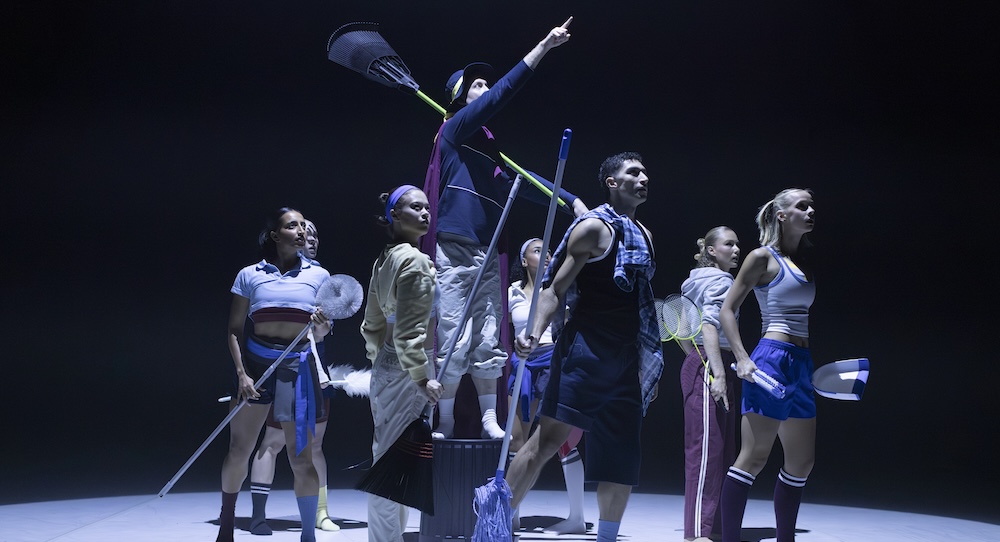
Pearson’s Save Point opened the night with welcome buoyancy. Rooted in memories of childhood gaming and backyard inventiveness, the work radiated warmth and humour. Liam Green appeared in a charming hat-and-coat ensemble, manipulating brooms, sticks and found objects with the delight of a child who can turn anything into a world. Pearson’s choreography slips between the logic of playground imagination and the angularity of early video-game characters, as dancers transition through what hints at “levels” and pixel-like motifs. Durriwiyn’s score, layering synthetic sounds with outdoor ambience, grows in texture as the work unfolds. The effect is playful and light-hearted – an affectionate tribute to the imaginative elasticity of childhood. It was the only truly uplifting piece on an otherwise weightier program, and while it made for a refreshing opener, its brightness might also have offered welcome relief later in the evening. Nevertheless, it was a thoroughly enjoyable start.
Jenkins’ contribution shifted the program into deeper, contemplative terrain. Rather than presenting landscape literally, she evokes the presence of home through atmosphere, pacing and the way the dancers settle into the floor. Impressions of coastline, soft horizons and mountain peaks that, for Jenkins, are bound to ancestral history emerge through the work’s quiet focus.
A particularly arresting moment features Naiara de Matos travelling slowly along a diagonal path while the ensemble moves around her in a softened, suspended rhythm – an image that feels like memory passing through time. Muted, bone-tones costumes and a score composed by Jackie Jenkins, Abigail Aroha Jensen and Stefan Jenkins amplify the work’s sense of lineage, grounding it in warmth and reverence. It’s a thoughtful and beautifully held piece, one that lingers in the body.
Fishwick’s Marathon, O Marathon expands the emotional landscape of the program into something sprawling and urgent. Drawing on imagery of endurance – physical, emotional, societal – the work places individual effort against collective strain. Dancers loop across the space, run on and off, collapse, regroup, and repeat. A recurring diagonal pathway becomes a kind of ritual corridor: a running formation gathers momentum, celebrates itself, falters, then begins again. As dancers peel away one by one, the genuine exhaustion of the final performers becomes part of the choreography’s truth.
Fishwick threads together a dense tapestry of references, echoes of ancient combat, relic-like objects such as a knight’s helmet, gestures toward protest, even a bag of oranges that later become small moments of rest and observation. The sound folds in applause and shifting textures that complicate the emotional terrain. There is a great deal happening – at times almost too much – but this only serves to emphasize the cyclical structure. The repetition, insistence and slow unravelling articulate an unmistakable sense of collective pressure. It’s ambitious, layered and compelling.
The evening’s final work turned toward dystopia, though not with the clarity or cohesion that its concept promised. Pigeon Humongous imagines a post-human world inhabited by mutated pigeon-people who communicate through movement and vocalisation. The introductory video hinted at humour and playful absurdity, prompting the audience to expect something offbeat and inventive.
Instead, the work maintained an unrelenting dark tone – visually and emotionally Berlage’s lighting kept much of the action in heavy shadow, which, following three demanding works, made it difficult to grasp the piece’s internal logic. Despite talk of a hybridised movement language, the choreography felt diffuse rather than distinctive. There were interesting partnering moments – unexpected drops and shared weight that genuinely surprised – but these were scattered within a structure that lacked clear direction.
Screaming appeared in several sections but often felt disjointed, and disconnected from the work’s world-building. Ultimately, Pigeon Humongous seemed underdeveloped and ill-suited to close not only the program but also the final New Breed season.
Across its 12-year run, New Breed has provided essential space for emerging choreographers to explore, risk, and refine. This final season encapsulated that mission: works that were playful, grounded, ambitious, uneven, generous and searching. Pearson’s sweetness, Jenkins’ depth and Fishwick’s scope affirmed the value of giving young artists a platform to stretch into. Even when a work faltered, as with Ritchie-Jones’, it spoke to the importance of offering room for experimentation.
As the curtain falls on New Breed, one hopes Sydney Dance Company continues to nurture new voices with the same openness and trust. This final program may have been varied in its successes, but it reminded us why initiatives like this matter – and what they make possible.
By Linda Badger of Dance Informa.
